Election Mythbusting 2025
It is local election season, so misinformation and appeals to bad faith are rife in our communities. Have you heard these myths about cycling and transport choice during the local elections?
Here is some information about how to respond.
PS – Voting takes place Tuesday 9 September to midday Saturday 11 October 2025!
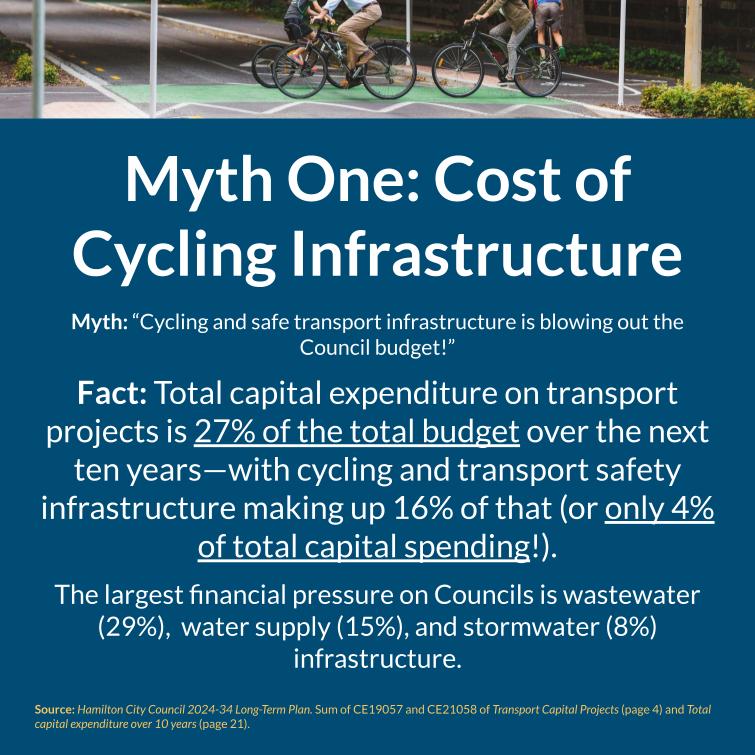
Myth One: Cost of Cycling Infrastructure
Myth: “Cycling and safe transport infrastructure is blowing out the Council budget!”
Fact: Total capital expenditure on transport projects is 27% of the total budget over the next ten years—with cycling and transport safety infrastructure making up 16% of that (or only 4% of total capital spending!).
The largest financial pressure on Councils is wastewater (29%), water supply (15%), and stormwater (8%) infrastructure.
Source: Hamilton City Council 2024-34 Long-Term Plan. Sum of CE19057 and CE21058 of Transport Capital Projects (page 4) and Total capital expenditure over 10 years (page 21). https://storage.googleapis.com/hccproduction-web-assets/public/Uploads/Documents/Content-Documents/Strategies-Plans-and-Projects/Long-Term-Plan/2024-34-LTP.pdf
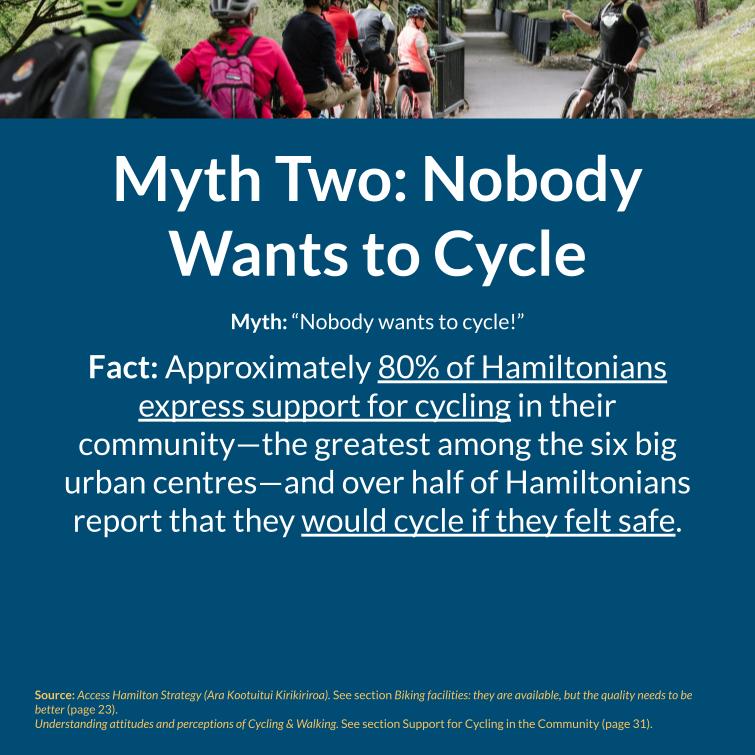
Myth Two: Nobody Wants Cycling Infrastructure
Myth: “Nobody wants to cycle!”
Fact: Approximately 80% of Hamiltonians express support for cycling in their community—the greatest among the six big urban centres—and over half of Hamiltonians report that they would cycle if they felt safe.
Source: Access Hamilton Strategy (Ara Kootuitui Kirikiriroa). See section Biking facilities: they are available, but the quality needs to be better (page 23). https://storage.googleapis.com/hccproduction-web-assets/public/Uploads/Documents/Strategies/24672-HCC-Access-Hamilton-Strategy-full.pdf
Understanding attitudes and perceptions of Cycling & Walking. See section Support for Cycling in the Community (page 31). https://nzta.govt.nz/assets/resources/understanding-attitudes-and-perceptions-of-cycling-and-walking/NZTA-Attitudes-to-cycling-and-walking-final-report-2018.pdf
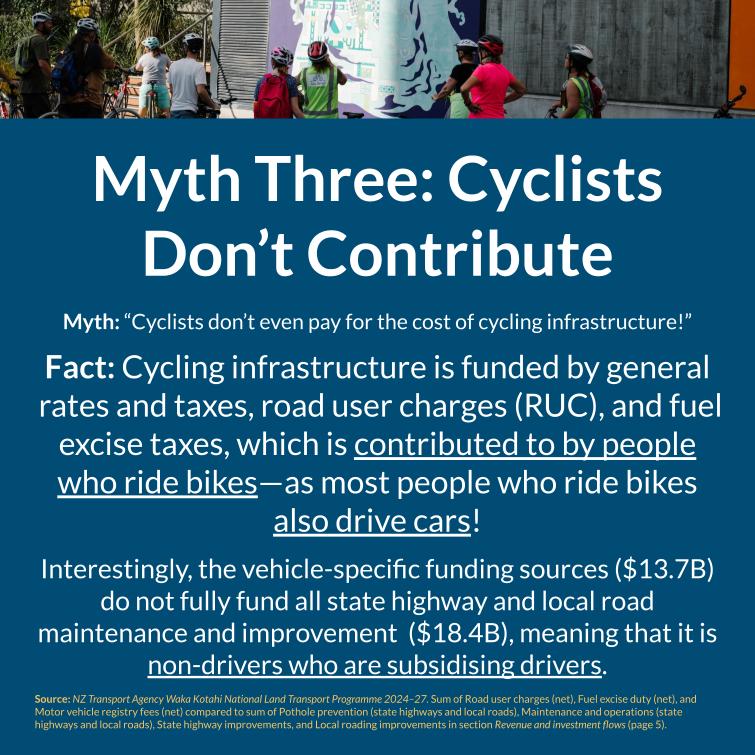
Myth Three: Cyclists Don’t Contribute to Costs
Myth: “Cyclists don’t even pay for the cost of cycling infrastructure!”
Fact: Cycling infrastructure is paid through by general rates and taxes as well as road user charges (RUC) and fuel excise taxes, much of which is contributed to by people who ride bikes—as most people who ride bikes also drive cars!
Interestingly, the vehicle-specific funding sources ($13.7B) do not fully fund all state highway and local road maintenance and improvement ($18.4B), meaning that it is non-drivers who are subsidising drivers.
Source: NZ Transport Agency Waka Kotahi National Land Transport Programme 2024–27. Sum of Road user charges (net), Fuel excise duty (net), and Motor vehicle registry fees (net) compared to sum of Pothole prevention (state highways and local roads), Maintenance and operations (state highways and local roads), State highway improvements, and Local roading improvements in section Revenue and investment flows (page 5). https://nzta.govt.nz/assets/planning-and-investment/nltp/2024/docs/2024-27-national-land-transport-programme.pdf
Myth Four: Cycling Slows Down and Frustrates Drivers
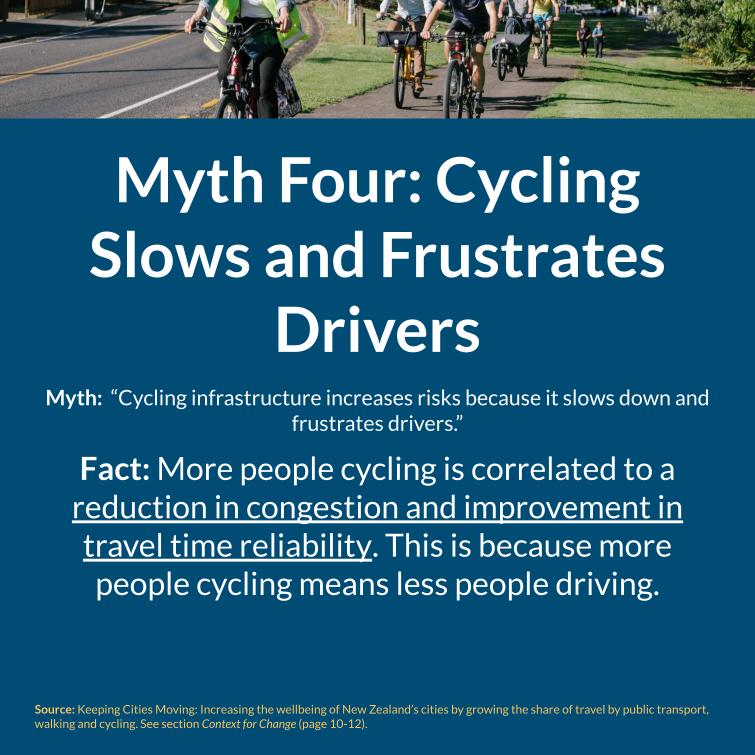
Myth: “Cycling infrastructure increases risks because it slows down and frustrates drivers.”
Fact: More people cycling is correlated to a reduction in congestion and improvement in travel time reliability. This is because more people cycling means less people driving.
Source: Keeping Cities Moving: Increasing the wellbeing of New Zealand’s cities by growing the share of travel by public transport, walking and cycling. See section Context for Change (page 10-12). https://nzta.govt.nz/assets/resources/keeping-cities-moving/Keeping-cities-moving.pdf
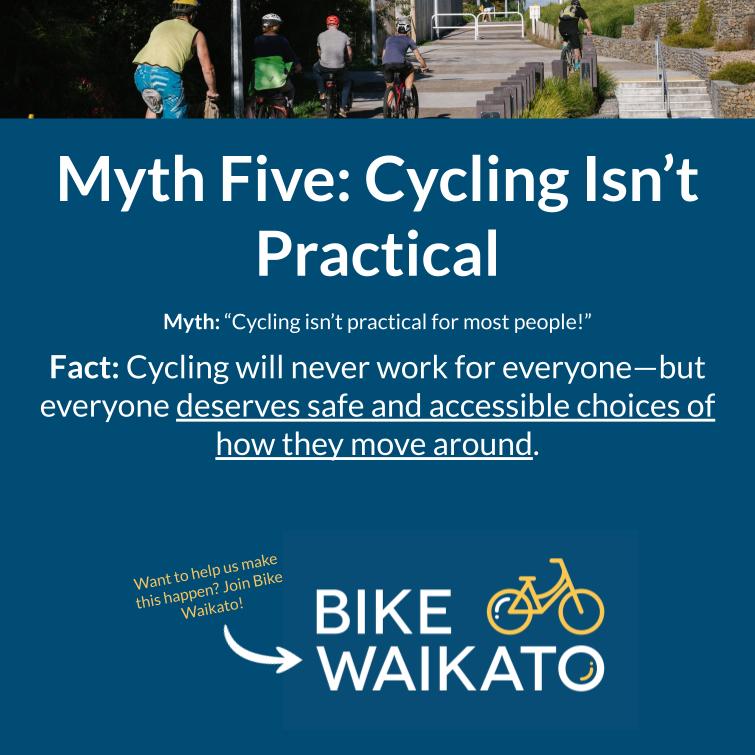
Myth Five: Cycling Isn’t Practical
Myth: “Cycling isn’t practical for most people!”
Fact: Cycling will never work for everyone—but everyone in our city deserves the choice of how they move around our city.